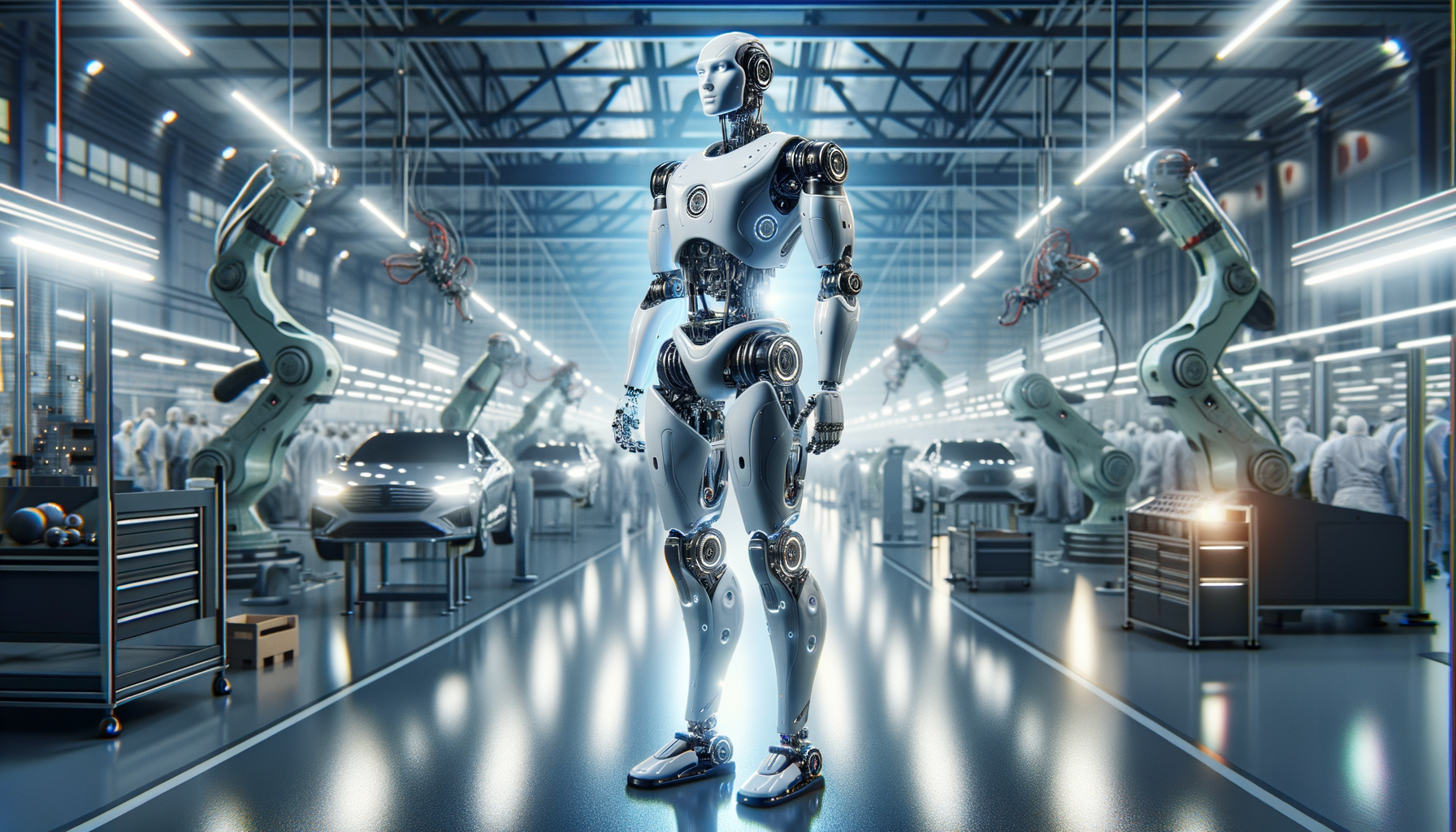
A serial entrepreneur, a BMW factory, and a valuation that makes Wall Street veterans nervous. Is Brett Adcock building the future — or the most expensive demo in Silicon Valley history?
Brett Adcock has done this before. In 2012, he co-founded Vettery, an AI-powered talent marketplace, grew it to 30,000 corporate clients across 18 global markets, and sold it to Adecco Group for roughly $110 million in 2018. Before the ink dried, he co-founded Archer Aviation — an electric air taxi company he took public via SPAC at a $2.7 billion valuation in 2021, raising over a billion dollars in the process. By 2022, he had left Archer to start Figure AI.
The pattern is not hard to see: serial escalation, each bet larger than the last. Vettery was a software play. Archer was hardware but bounded — air taxis for a defined route structure. Figure AI is something else entirely. It is a bet on rearchitecting the labor economy of human civilization using robots shaped like people.
That ambition now carries a price tag: $39 billion.
The Pitch
Figure's founding thesis is deceptively simple. The global labor market is running short of workers willing to do repetitive, physically demanding, ergonomically damaging industrial tasks. The gap is structural — aging populations, shifting worker expectations, shrinking birth rates. No demographic wave is coming to fill it.
The solution, Adcock argues, is a robot that fits into the world humans already built. Doorknobs, assembly lines, warehouse shelving units, kitchen counters — all designed for the human body. Purpose-built industrial arms can do specific jobs, but they can't cross a factory floor or open a cabinet. A robot with two legs, two arms, and human-scale dimensions can.
"Every home will have a humanoid," he told Time in October 2025.
At Dreamforce the same year: "We're building a new species, not robots."
These are not modest statements. They are, depending on who you ask, either visionary or reckless.
The Money
Investors have placed their bets. Figure has raised approximately $1.75 billion across three rounds:
- May 2023 — $70M: Led by Parkway Venture Capital. Enough to prove the concept.
- February 2024 — $675M at $2.6B valuation: The breakout moment. Jeff Bezos, Microsoft, Nvidia, Intel, and — pointedly — the OpenAI Startup Fund all participated. Amazon's Industrial Innovation Fund joined too.
- September 2025 — $1B+ at $39B valuation: Led again by Parkway, joined by Brookfield Asset Management, Qualcomm, T-Mobile, and Salesforce. OpenAI was conspicuously absent.
That last round represented a 15x valuation jump in 18 months. At $39 billion, Figure AI is worth more than Ford Motor Company — a corporation with 186,000 employees, a century of manufacturing expertise, and actual revenue. Figure has roughly 180 employees and one confirmed commercial customer.
Whether this is visionary pricing or bubble arithmetic depends on what you think Adcock is actually selling.
The Robots
Figure has built three generations of humanoid hardware. The Figure 01 was a proof-of-concept. The Figure 02 was what actually shipped to BMW's Spartanburg plant in South Carolina — the largest BMW manufacturing facility in the world — where it has been inserting sheet metal parts into fixtures on an active assembly line. Per Figure's own reporting, F.02 contributed to the production of 30,000 vehicles.
Figure 03, announced October 2025, is a complete redesign — built for the Helix AI system and for eventual home use. It has palm-embedded cameras, custom tactile sensors capable of detecting forces as small as three grams, wireless inductive charging, a 5-hour battery, and soft foam coverings with washable textile exteriors. It is designed to be near a sleeping child without causing harm. That is a different engineering problem than being near a BMW chassis.
The Divorce That Defined 2025
On February 4, 2025, Adcock posted on X:
"Figure made a major breakthrough on fully end-to-end robot AI, built entirely in-house. We're excited to show you in the next 30 days something no one has ever seen on a humanoid."
What he did not say: Figure was ending its partnership with OpenAI. TechCrunch reported the split the following day. The reason given was that large language models were "getting smarter yet more commoditized" — the implication being that OpenAI's AI no longer represented a sustainable competitive moat.
Eighteen days later, Figure unveiled Helix — a Vision-Language-Action model built entirely in-house. A single neural network controlling every behavior: picking, placing, using drawers, navigating a room, collaborating with a second robot. No task-specific fine-tuning. Input from cameras; output to motors. From pixels to torque, end-to-end.
Helix 02, released in early 2026, added full-body autonomy, pharmaceutical-grade dexterity (extracting individual pills, dispensing precise syringe volumes), and room-scale navigation in environments the robot has never seen.
The January 2026 demo showed a Figure robot completing a full dishwasher cycle in a standard kitchen — four minutes, zero human intervention. The robotics community, which is not easily impressed, was.
This is the deeper bet Adcock is making: that the moat in humanoid robotics is not the body but the brain, and that in-house AI — trained on embodied robot experience, not internet text — will prove impossible to replicate by anyone who doesn't have robots actually working in the world.
The Controversy
In April 2025, Fortune published an investigation by journalist Jason Del Rey questioning whether Figure had overstated the scope of its BMW deployment. The piece suggested the robots were performing limited, controlled tasks rather than the broad assembly-line integration implied by Figure's communications — and raised the timing question: the claims were being amplified just as Figure was reportedly in talks to raise $1.5 billion at a near-$40 billion valuation.
Adcock's response was immediate and legally threatening:
"What we won't stand for are the mischaracterizations and downright lies written in the recent Fortune article... Figure's litigation counsel will aggressively pursue all available legal remedies — including, but not limited to, defamation claims."
The lawsuit, if it ever existed in more than threat form, has not materialized publicly. The dispute illustrates a structural tension at the heart of Figure's story: a company at this valuation needs the BMW partnership to read as transformational, not as a sophisticated pilot program. The difference matters — not just for optics, but for whether the underlying math holds.
BMW's official statement, for what it's worth, confirms real work: "Together with Figure, the BMW Group is currently testing and evaluating how humanoid robots can be used safely in automobile production... using a robot can save employees from having to perform ergonomically awkward and tiring tasks." That is validation, but it is also carefully worded.
The Arithmetic
Figure has announced BotQ — a dedicated manufacturing facility with initial capacity of 12,000 humanoids per year — and a stated goal of 200,000+ deployed robots by 2029. At 12,000 units per year and a four-year runway, you get 48,000 robots without further expansion. Reaching 200,000 requires a scale-up that no humanoid manufacturer has yet demonstrated is achievable.
The valuation assumes it is.
Two Futures
If Figure succeeds — if Helix generalizes, if BotQ scales, if the home deployment works — the consequences are genuinely civilizational. A general-purpose robot at commercial scale would be a labor-market event comparable to containerization, electrification, or the internet. The $39 billion valuation looks not just rational but cheap. Adcock becomes the most important industrialist of the 21st century.
If Figure fails — or, more likely, if it gets the technology right but stumbles on manufacturing economics, safety regulation, or the brutal unit economics of physical hardware — the $39 billion looks like the high-water mark of a robotics hype cycle. One commercial customer, 180 employees, and a valuation built on demos and ambition.
The honest answer, in February 2026, is that both outcomes are live. Figure has done more than most doubters expected. It has not yet done what the valuation requires.
Brett Adcock has won before at long odds. He has also never tried to win at odds this long.
Published by themimic.io — tracking the humanoid robotics industry without the hype.